Carbon Footprint of Everyday Foods Explained

Have you ever considered the carbon footprint behind each bite of the food you enjoy? From the fields where crops are grown, to the livestock on farms, through processing facilities and long-distance transportation, food carries a significant amount of greenhouse gas emissions before reaching our plates. The total amount of greenhouse gases produced throughout the food’s life cycle—from production to consumption—is known as its carbon footprint, usually expressed in carbon dioxide equivalent (CO₂e).
According to the Food and Agriculture Organization (FAO) of the United Nations, the global food system contributes roughly one-third of total greenhouse gas emissions, highlighting the close connection between our daily dietary choices and climate change. Understanding food carbon footprints is not only a scientific exercise but also a practical way for individuals to participate in climate action.
Main Sources of Carbon Emissions in the Food System
Research by Hannah Ritchie and others identifies three major sources of carbon emissions in the food system: agricultural production, land use change, and the supply chain, which includes processing, transportation, packaging, and retail.
1. Agricultural Production: The Core Source
Agricultural production is the dominant contributor to food-related emissions, accounting for more than half of the total. Livestock, especially ruminants like cows and sheep, produce significant amounts of methane through enteric fermentation, a greenhouse gas far more potent than CO₂. In addition, manure management, fishing fuel consumption, fertilizer application, and rice cultivation all release greenhouse gases. Fuel consumed by farm machinery also adds to the emissions.
2. Land Use Change: The Hidden Cost of Deforestation
Expanding farmland often requires converting forests and natural ecosystems into agricultural land, releasing stored carbon from soil and vegetation. This is the largest single contributor within the food system, responsible for around 27% of emissions. In tropical regions, deforestation for crop cultivation significantly reduces the planet’s capacity to sequester CO₂.
3. Supply Chain: Processing and Transportation
Compared to agriculture and land use change, emissions from processing, packaging, transportation, and retail are relatively smaller, accounting for about 18% of total food system emissions. While long-distance transportation is often emphasized in public discussions, its share of global food emissions is limited. This indicates that prioritizing the types of food we eat, particularly low-carbon options, is more effective for emission reduction than focusing solely on local sourcing.
Carbon Footprint Differences Among Food Types
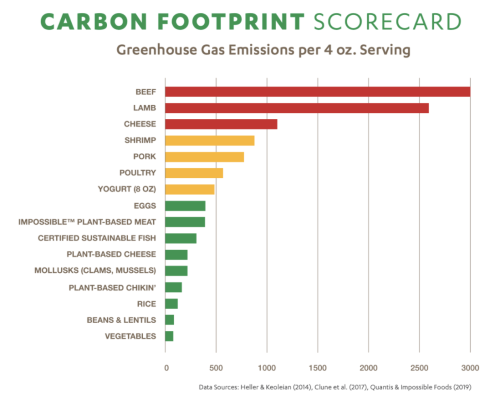
Carbon footprints vary dramatically between food types, with animal-based foods generally having much higher emissions than plant-based ones.
1. Meat and Dairy: Heavy Carbon Contributors
Meat has the highest carbon footprint among foods, often an order of magnitude greater than plant-based products. Beef is the most carbon-intensive, with about 60kg CO₂e per kilogram of beef produced—over ten times the footprint of chicken. Emissions come from the animal’s digestion, feed production, and land use changes. Sheep and goat meat are also high, while pork, chicken, and fish are comparatively lower.
Cheese, made primarily from cow or sheep milk, has a carbon footprint of approximately 21kg CO₂e per kilogram. Milk itself contributes about 3kg CO₂e per kilogram, more than three times the footprint of soy milk. These figures illustrate the substantial resource use and greenhouse gas emissions associated with animal-derived foods.
2. Oils and Grains: Contrasting Plant-Based Foods
Palm oil and olive oil have carbon footprints of roughly 8kg CO₂e/kg and 6kg CO₂e/kg, respectively. Among grains, rice has a footprint of 4kg CO₂e/kg, while wheat is much lower at 1.4kg CO₂e/kg. Most vegetables and fruits are significantly lower: root vegetables average 0.4kg CO₂e/kg, and fruits such as apples and citrus are around 0.3–0.4kg CO₂e/kg.
3. Chocolate and Coffee: High-Emission Plant-Based Foods
Although plant-based, chocolate and coffee have high carbon footprints, approximately 19kg CO₂e per kilogram. The major contributors are large-scale land use changes in tropical rainforests, nitrogen fertilizer application, and energy-intensive processing. Cocoa cultivation often replaces forests, reducing the Earth’s carbon absorption capacity, while coffee production releases nitrous oxide from soil, a gas hundreds of times more potent than CO₂.
4. Beans and Nuts: Core Low-Carbon Foods
Legumes, nuts, and most vegetables and fruits are low-carbon foods. Producing 1 kilogram of soybeans or lentils emits only about 0.9kg CO₂e. These foods are essential components of a low-carbon diet and play a crucial role in reducing overall food-related emissions.
Strategies for Practicing a Low-Carbon Diet
Dietary choices are daily actions that everyone can participate in, making them low-cost but high-potential avenues for emission reduction. According to the Lancet–EAT Commission, a plant-forward flexitarian diet could reduce carbon emissions by approximately 15% while preventing 15 million premature deaths annually. Researchers at Oxford University also found that widespread adoption of plant-based diets could reduce global food production costs by nearly $1 trillion per year, due to the lower carbon footprint and resource use of plant-based foods compared to animal products.
1. Adjust Protein Sources
Reducing red meat, particularly beef and lamb, and replacing them with chicken, fish, or plant-based proteins like tofu and pea protein can substantially lower carbon emissions.
2. Increase Vegetables, Fruits, and Whole Grains
A diet rich in vegetables, fruits, and whole grains not only has a low carbon footprint but also provides essential nutrients and dietary fiber, benefiting both health and the environment.
3. Avoid Food Waste
Globally, food waste contributes about 8–10% of total greenhouse gas emissions. Buying only what is needed, proper storage, and finishing meals are practical actions that directly reduce emissions.
4. Prioritize Food Choice Over Transport Distance
While consuming local and seasonal food reduces transportation emissions, research shows that food type has a much larger impact on carbon footprint than distance. Choosing low-carbon foods should take precedence over merely focusing on local sourcing.

Global Policy and Food System Transformation
From COP28 to COP30, transforming agriculture and the food system has become a central issue in climate governance. Policy discussions increasingly focus on producing food in low-carbon ways and making diets more sustainable.
Sustainable transformation of the food system is complex and requires coordinated efforts from policymakers, industry, technology, and the public. Innovations, industry collaboration, policy support, and conscious consumer behavior are all essential for creating a green food supply chain. As standards for carbon accounting become unified, emission reduction technologies advance, and coordination mechanisms improve, food supply chains can achieve both emissions reduction and efficiency gains, delivering food with a “green footprint” to the table.
Conclusion
A low-carbon diet is not just an abstract concept—it is a concrete action that can be implemented daily. Future food choices will determine our impact on climate, making each meal an opportunity to support both personal health and environmental sustainability. By making climate-friendly decisions at the table, we can turn environmental responsibility into a tangible practice.
References
1. FAO. (2013). Tackling climate change through livestock: A global assessment of emissions and mitigation opportunities. Food and Agriculture Organization of the United Nations.
2. Ritchie, H., & Roser, M. (2023). Environmental impacts of food production. Our World in Data.
3. Willett, W., Rockström, J., Loken, B., et al. (2019). Food in the Anthropocene: The EAT–Lancet Commission on healthy diets from sustainable food systems. The Lancet, 393(10170), 447–492.
4. Poore, J., & Nemecek, T. (2018). Reducing food’s environmental impacts through producers and consumers. Science, 360(6392), 987–992.
5. Garnett, T. (2011). Where are the best opportunities for reducing greenhouse gas emissions in the food system?. Food Policy, 36(Supplement 1), S23–S32.
Recommended for you